
Traditional Individual Retirement Accounts (IRAs), which were created in 1974, are owned by
roughly 41 million U.S. households. And Roth IRAs, created as part of the Taxpayer Relief Act
in 1997, are owned by nearly 32 million households.1
Both are IRAs. And yet, each is quite different.
Up to certain limits, traditional IRAs allow individuals to make tax-deductible contributions to
their account(s). Distributions from traditional IRAs are taxed as ordinary income, and if taken
before age 59½, may be subject to a 10% federal income tax penalty. Generally, once you reach
age 73, you must begin taking required minimum distributions.2,3
For individuals covered by a retirement plan at work, the deduction for a traditional IRA in 2024
is phased out for incomes between $123,000 and $143,000 for married couples filing jointly and
between $77,000 and $87,000 for single filers.4
Also, within certain limits, individuals can make contributions to a Roth IRA with after-tax
dollars. To qualify for a tax-free and penalty-free withdrawal of earnings, Roth IRA distributions
must meet a five-year holding requirement and occur after age 59½.
Like a traditional IRA, contributions to a Roth IRA are limited based on income. For 2024,
contributions to a Roth IRA are phased out between $230,000 and $240,000 for married couples
filing jointly and between $146,000 and $161,000 for single filers.4
In addition to contribution and distribution rules, there are limits on how much can be
contributed each year to either IRA. In fact, these limits apply to any combination of IRAs; that
is, workers cannot put more than $7,000 per year into their Roth and traditional IRAs combined.
So, if a worker contributed $4,000 in a given year into a traditional IRA, contributions to a Roth
IRA would be limited to $3,000 in that same year.4
Individuals who reach age 50 or older by the end of the tax year can qualify for “catch-up”
contributions. The combined limit for these is $8,000.4
Both traditional and Roth IRAs can play a part in your retirement plans. And once you’ve
figured out which will work better for you, only one task remains: open an account.5
Features of Traditional and Roth IRAs
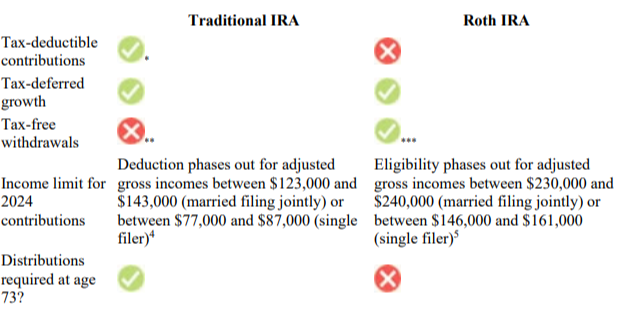
* Up to certain limits
** Distributions from traditional IRAs are taxed as ordinary income, and if taken before age
59½, may be subject to a 10% federal income tax penalty. Generally, once you reach age 73, you
must begin taking required minimum distributions.
*** To qualify, Roth IRA distributions must meet a five-year holding requirement and occur
after age 59½.
1. ICI.org, February 2023
2. IRS.gov, 2024. In most circumstances, once you reach age 73, you must begin taking required
minimum distributions from a Traditional Individual Retirement Account (IRA). You may
continue to contribute to a Traditional IRA past age 70½ as long as you meet the earned-income
requirement.
3. Up to certain limits, traditional IRAs allow individuals to make tax-deductible contributions
into their account(s). Distributions from traditional IRAs are taxed as ordinary income, and if
taken before age 59½, may be subject to a 10% federal income tax penalty. Generally, once you
reach age 73, you must begin taking required minimum distributions.
4. IRS.gov, 2024
5. The Tax Cuts and Jobs Act of 2017 eliminated the ability to "undo" a Roth conversion.
The content is developed from sources believed to be providing accurate information. The
information in this material is not intended as tax or legal advice. It may not be used for the
purpose of avoiding any federal tax penalties. Please consult legal or tax professionals for
specific information regarding your individual situation. This material was developed and
produced by FMG Suite to provide information on a topic that may be of interest. FMG Suite is
not affiliated with the named broker-dealer, state- or SEC-registered investment advisory
firm. The opinions expressed and material provided are for general information, and should not
be considered a solicitation for the purchase or sale of any security. Copyright FMG Suite.